

Are you certain your water hygiene contractor is actually doing the work you pay for, or are you just filing away opaque reports and hoping for the best? It’s a common trap. Most UK dutyholders feel buried under the technical weight of ACOP L8 and the 2024 updates to HSG274 Part 2. You likely suspect that a signed service sheet doesn’t always guarantee safety, yet without a regular water hygiene contractor audit, it’s almost impossible to challenge the status quo with confidence.
The reality is that the HSE holds you accountable for your site’s safety, regardless of who you hire. This guide shows you how to cut through the corporate fluff to secure defensible evidence of compliance. You’ll learn how to verify engineer competency and transform confusing paperwork into a clear, no-nonsense summary of your site’s safety. We’re stripping away the jargon to help you regain control and find genuine peace of mind.
Key Takeaways
- Understand why a professional water hygiene contractor audit is a systematic check of performance against ACOP L8, moving beyond simple box-ticking.
- Learn why engineer signatures in a logbook don’t guarantee safety and how to verify actual competency during site visits.
- Discover how an independent “Contract MOT” can identify unnecessary services and reduce costs whilst strengthening your compliance.
- Follow a practical framework for shadowing engineers and reviewing your Written Scheme to create a defensible evidence trail for the HSE.
- Shift from opaque, jargon-heavy reports to transparent, plain-English summaries that provide genuine peace of mind for dutyholders.
What is a Water Hygiene Contractor Audit?
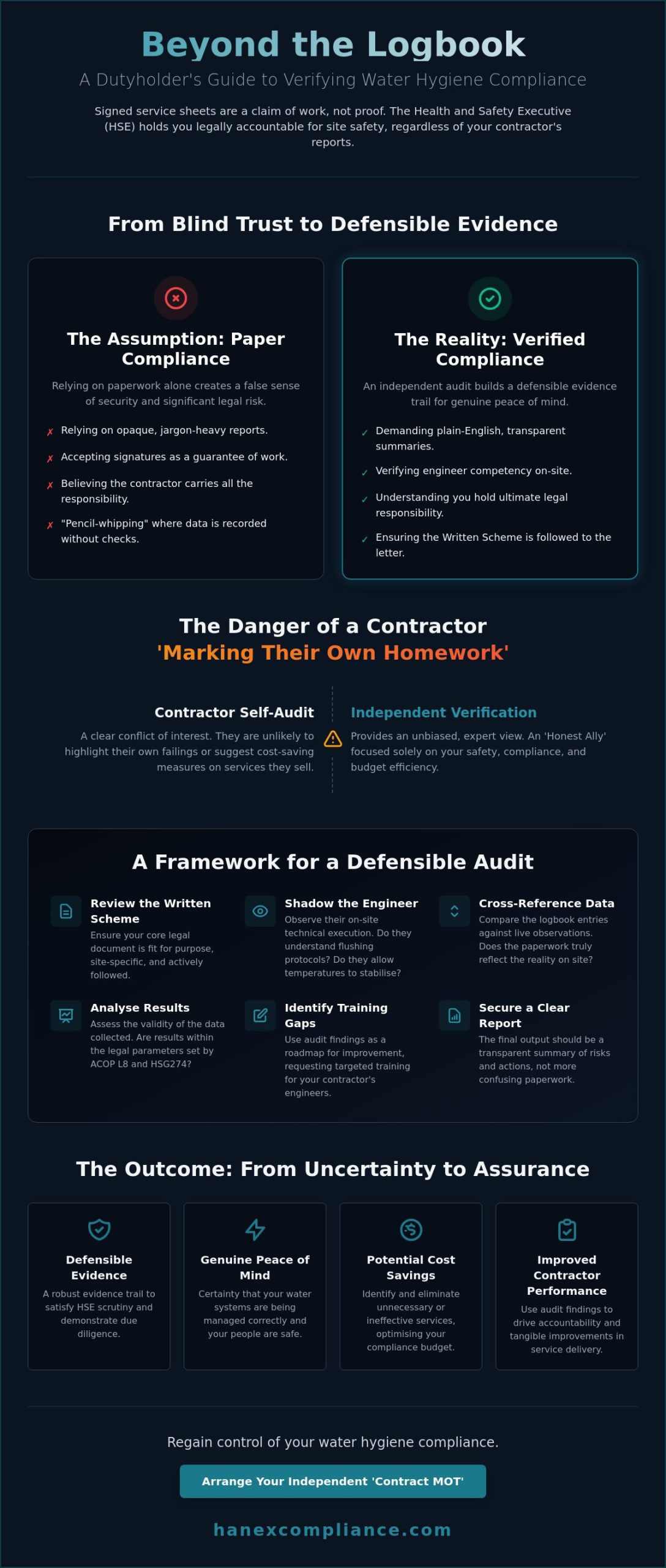
A water hygiene contractor audit is not a courtesy review of your invoices or a quick glance at a service sheet. It is a systematic, evidence-based investigation into whether your service provider is actually meeting the requirements of ACOP L8. While many dutyholders believe that receiving a monthly folder of reports equals compliance, this is often a dangerous assumption. An audit is the process of stepping back and asking: “Is what’s written on this paper actually happening on my site?”
Think of this as a “this-not-that” scenario. A standard service report is a claim of work; a compliance audit is the proof of work. Most contractors are excellent at filling out logbooks, but a signature doesn’t always mean a tank was inspected or a temperature was taken correctly. As the dutyholder, your role is to oversee contractor behaviour, not just collect their paperwork. You are the one the HSE will look to if things go wrong. A professional water hygiene contractor audit bridges the gap between blind trust and defensible evidence.
The Legal Basis: ACOP L8 and HSG274
The statutory requirement for managing water safety is laid out in the HSE’s Approved Code of Practice L8 and the technical guidance in HSG274. These documents aren’t suggestions; they are the benchmarks that courts use to determine if you’ve been negligent. Effective management of the Legionella bacterium requires more than just pouring chemicals into a tank. It requires a robust Written Scheme of Control that is followed to the letter.
In the eyes of the law, “I didn’t know the contractor wasn’t doing it” is never a defensible position. You can delegate the tasks, but you cannot delegate the legal responsibility. The Written Scheme is your contract with the law, and the audit is how you prove you are keeping your end of the bargain. If your contractor’s performance deviates from that scheme, your compliance isn’t just weak; it’s non-existent.
Who Should Carry Out the Audit?
There is a significant danger in allowing contractors to “mark their own homework.” If the company providing your monthly monitoring is the same company auditing their own performance, you lack the independence required for a defensible audit. It’s a clear conflict of interest. They are unlikely to highlight their own failings or suggest that certain services they sell you are actually unnecessary.
Independence is the most critical factor here. You need a compliance partner who doesn’t have a vested interest in selling you remedial works or chemicals. An independent auditor provides an unbiased view of your site’s safety. They act as your “Honest Ally,” telling you exactly what you need to hear to stay safe and compliant, rather than what will simply help them hit a sales target. This distinction is the difference between a service provider and a true compliance partner.
Assessing Engineer Competency: Moving Beyond the Logbook
A signature in a logbook is just ink on paper. It doesn’t prove a temperature was taken correctly, or that a showerhead was actually descaled. Too many dutyholders rely on these signatures to satisfy their legal obligations under the Approved Code of Practice (ACOP L8). But when the HSE visits, they don’t just look at the dates; they look at the validity of the data. If your engineer is “pencil-whipping”, entering data without actually performing the physical check, your compliance is a house of cards.
This is where a water hygiene contractor audit becomes essential. It moves the focus from the office to the plant room. We often see a “Competency Gap” where engineers have the right certificates but fail on site-specific execution. They might know the theory of thermoregulation but struggle to identify the correct sentinel points on a complex, modified system. An audit observes their actual technical execution, ensuring they aren’t just following a generic checklist but are actually managing the risks specific to your building.
Verifying Technical Skills on Site
During a live audit, we watch how an engineer handles the tools of the trade. Do they allow temperatures to stabilise before recording? Do they understand the flushing protocols for dead legs that haven’t been used in weeks? Competency is the intersection of knowledge, skill, and site-specific awareness. Without all three, the risk remains. If an engineer cannot explain why they are testing a specific outlet, they aren’t managing your risk; they’re just going through the motions. Identifying these lapses early prevents small errors from becoming systemic failures.
Identifying and Closing Training Gaps
Audit failures shouldn’t just be a reason for a stern email to the contractor. They are a roadmap for improvement. You can use these findings to request targeted Legionella awareness training that focuses on the exact areas where the engineer or your internal staff are struggling. Bespoke, site-specific training always beats generic off-the-shelf courses because it deals with the reality of your pipework, not a textbook diagram. Turning an audit failure into a professional development opportunity strengthens your safety culture. If you suspect your current monitoring is just a box-ticking exercise, an Engineer Competency Audit provides the clarity you need to fix the problem before it leads to a non-conformance.
The Benefits of Independent Verification Over Contractor Self-Audits
Relying on a contractor to audit their own performance is like asking a student to grade their own exam paper. It lacks the critical distance needed to spot systemic failures. An independent water hygiene contractor audit provides a fresh set of eyes on an old contract. We call this the “Contract MOT”. It is about stripping away the comfortable assumptions that develop over years of service and looking at the cold, hard facts of your site’s safety. Trust is not a management strategy; verification is.
An independent auditor acts as your “Honest Ally”. Their only objective is your compliance, not the sale of more chemicals or remedial works. This independence creates a truly defensible trail. When an inspector from the HSE or a local authority asks how you monitor your service provider, you can present an unbiased report. This is far more robust than a stack of self-congratulatory service sheets provided by the person doing the work. You need a partner who tells you what you need to hear, not what helps them hit a quarterly sales target.
Unbiased Evidence for Dutyholders
Unbiased data is the only way to truly manage risk. It gives you the leverage to hold your contractor accountable to their Service Level Agreements (SLAs). If they missed a visit or failed to record a critical temperature, an independent audit will catch it. This removes the “commercial fear” that contractors sometimes use to push expensive, unnecessary upgrades. You get the facts you need to make informed decisions based on the actual requirements of HSE ACOP L8, rather than a biased sales pitch disguised as advice.
Cost Optimisation Through Compliance
Audits often uncover “over-servicing”. This occurs when you are paying for tasks that the law simply does not require for your specific water system. A Water Hygiene Contract MOT often pays for itself by identifying these unnecessary costs and removing them from your monthly bill. By streamlining your Written Scheme to focus only on high-risk areas, you reduce your administrative burden and your overheads. It is about being lean, compliant, and in total control of your budget. We help you stop paying for “box-ticking” and start paying for actual safety.
A Practical Framework for Conducting a Defensible Contractor Audit
A defensible water hygiene contractor audit requires a structured approach. It isn’t a casual walkaround. It is a methodical verification process designed to protect the dutyholder from legal liability. If you can’t prove you’ve checked the work, you haven’t managed the risk. This framework ensures that your oversight is active, documented, and capable of withstanding scrutiny from the HSE or local authority inspectors.
- Step 1: Review the current Written Scheme and Risk Assessment. These are your benchmarks. If the contractor isn’t following the specific plan you’ve paid for, they are failing their contractual and legal duties.
- Step 2: Shadow the engineer during a routine maintenance visit. Watch their technique. Do they use calibrated thermometers? Do they actually visit every outlet on the list, or do they skip the hard-to-reach areas?
- Step 3: Cross-reference physical site conditions with logbook entries. If the logbook says a tank was inspected yesterday but the hatch is rusted shut, you have a major problem with “pencil-whipping.”
- Step 4: Evaluate the quality and accuracy of sampling and monitoring data. Look for “ghost data,” which are results that look too perfect to be real, such as identical temperatures recorded across different floors.
- Step 5: Produce a plain-English action plan. This should be a list of prioritised tasks that address the gaps found. A list of failures is useless without a clear path to resolution.
Validating Site Records and Physical Assets
The audit must move beyond the plant room. We check that every outlet is actually being flushed, not just the “easy” ones near the staff kitchen. A site-specific audit must reflect the actual pipework and layout of your building, not a generic template used for every client. We verify the physical condition of cold water storage tanks and calorifiers. We look for signs of stagnation, debris, or poor insulation that a standard service report might gloss over. This physical verification is the only way to ensure your assets are being maintained in accordance with the law.
The Audit Report: Clarity Over Volume
A 100-page report is often a sign of a “box-ticking” exercise. It’s designed to look impressive on a shelf whilst hiding the real issues in a sea of technical jargon. We prefer punchy summaries that lead to immediate action. Every finding must be “defensible,” meaning it can stand up to legal scrutiny if the HSE ever investigates your site. You need a document that tells you exactly what is wrong and how to fix it. If you want to ensure your contractor is delivering value, an independent Engineer Competency Audit is the best way to secure your site’s compliance trail.
How Hanex Compliance Ltd Delivers Plain-English Contractor Assurance
At Hanex Compliance Ltd, we don’t believe in 100-page reports filled with technical jargon that nobody reads. We provide the facts you need to stay safe and nothing else. Our commitment to independence is absolute. We don’t sell remedial works, and we don’t sell chemicals. This means our advice is never a thinly veiled sales pitch for a new tank or a disinfection service. When we conduct a water hygiene contractor audit, our only goal is to verify that your current provider is doing exactly what you pay them to do.
We act as your “Honest Ally” in a complex industry. Our Engineer Competency Audits are designed to strengthen your internal team and your contractor’s performance. We don’t just point out failures; we provide the clarity needed to fix them. By stripping away the corporate fluff, we help UK businesses move from a state of “hoping for compliance” to “knowing they are safe.” It’s about practical, site-specific reality rather than administrative theory.
Why Independence Matters to Your Business
If your auditor is also your service provider, the conflict of interest is unavoidable. Our unbiased position ensures your interests always come first. You get the peace of mind that comes from a truly objective compliance partner. We look at the actual condition of your pipework and the behaviour of your engineers. If a task is unnecessary, we tell you. If a task is being missed, we highlight it. This transparency allows you to prioritise your budget on high-risk areas whilst cutting out the waste of over-servicing.
Getting Started with a Contractor Audit
Getting started is straightforward. We don’t hide behind complex onboarding processes. Whether you need a one-off site visit or a comprehensive review of a long-term contract, Hanex Compliance Ltd moves quickly to provide the assurance you need. From the moment we arrive on site to the delivery of the final report, our focus is on efficiency and accuracy. You can expect a punchy, actionable summary that gives you total control over your water hygiene programme. Don’t leave your compliance to chance or contractor self-policing. Book an independent audit to verify your contractor’s performance and secure the defensible evidence your business requires.
Secure Your Compliance Trail Today
Relying on a contractor to self-police their own work is a risk no UK dutyholder can afford to take. We’ve seen how a systematic water hygiene contractor audit transforms opaque, jargon-filled reports into clear, defensible evidence of safety. It’s about moving from administrative theory to the site-specific reality of your pipework. By verifying engineer competency and stripping away unnecessary services, you don’t just protect your site; you optimise your budget.
Hanex Compliance Ltd provides the independent, specialist UK water hygiene expertise you need to regain control. We don’t sell chemicals or remedial works; our advice is always unbiased and focused entirely on your compliance. You get plain-English reporting and the peace of mind that comes from knowing your site is genuinely safe. This approach ensures your Written Scheme remains lean and effective rather than bloated and expensive.
Ready to stop guessing and start verifying? Get a straight-talking quote for an independent contractor audit and ensure your compliance is built on facts, not assumptions. You’ve got the responsibility; let us give you the evidence to support it.
Frequently Asked Questions
What is the difference between a Legionella risk assessment and a water hygiene contractor audit?
A risk assessment identifies the physical hazards within your water system, such as dead legs or temperature issues. A water hygiene contractor audit evaluates the performance of the people hired to manage those risks. It’s the difference between identifying a problem and verifying that your contractor is actually fixing it as agreed.
How often should I audit my water hygiene contractor?
Annual audits are the standard for most UK dutyholders to maintain a defensible compliance trail. You should also consider an audit if you’ve recently started a new contract or if you’ve noticed a decline in the quality of your monthly reports. High-risk environments, such as healthcare sites, may require more frequent verification to ensure safety.
Can my current contractor perform their own competency audit?
They can, but it’s a clear conflict of interest that won’t stand up well under legal scrutiny. A contractor auditing themselves is simply “marking their own homework.” For a truly defensible position, you need an independent third party to verify that the work is being done correctly without any commercial bias.
What happens if the audit finds my contractor is not compliant?
You’ll receive a prioritised action plan that identifies exactly where the service is failing. Use this document to hold your contractor accountable during your next performance review. It provides the factual evidence you need to demand improvements or, if necessary, provide grounds for terminating a failing contract.
Do I need a contractor audit if I have a small building?
Yes, because the legal duties under ACOP L8 apply regardless of your building’s size. Small sites are often more prone to “pencil-whipping” because engineers might assume the risks are low. An audit ensures that even simple systems are maintained correctly and that you aren’t paying for complex services you don’t actually need.
What qualifications should a water hygiene auditor have?
Your auditor should possess specialist UK water hygiene expertise and a deep, practical understanding of HSG274 and ACOP L8. Most importantly, they should be independent. They shouldn’t have any links to companies that sell chemicals or remedial works, as this ensures their findings are based on safety rather than sales targets.
How long does a typical water hygiene contractor audit take?
A standard audit for a single building usually takes one full day on site. This time is spent shadowing your engineer, inspecting physical assets like tanks and calorifiers, and cross-referencing logbook data. Larger or more complex industrial sites may require additional time to ensure every aspect of the Written Scheme is verified.
Will an independent audit help me save money on my water hygiene contract?
It frequently does by identifying “over-servicing” where you are paying for tasks the law doesn’t actually require. Many contractors use generic templates that include monthly checks for systems that only need quarterly monitoring. We help you cut this administrative fluff, often saving more in service fees than the cost of the audit itself.