

Most Legionella risk assessments are little more than expensive doorstops or, worse, glorified sales pitches for plumbing work you don’t actually need. It’s a common frustration for duty holders across the UK. You’re often handed a thick, jargon-heavy folder that ticks a regulatory box but leaves you completely in the dark about your actual site risks. You deserve a legionella risk assessment that prioritises genuine safety over contractor sales targets.
We know the headache of trying to decipher complex ACOP L8 and HSG274 requirements whilst dodging contractors who use compliance as a convenient excuse to find unnecessary remedial work. This guide is designed to cut through the industry noise. You’ll discover how to secure a defensible, plain-English assessment that protects your people without the usual corporate fluff or hidden agendas. We’ll show you how to move from administrative confusion to a clear, actionable plan that provides genuine legal peace of mind. By the end of this article, you’ll have a straightforward roadmap for achieving unbiased water safety that stands up to scrutiny without breaking the bank.
Key Takeaways
- Learn why a defensible legionella risk assessment must be a site-specific living document rather than a generic template that gathers dust.
- Understand the core requirements of ACOP L8 and HSG274 through a plain-English lens that removes legal confusion and corporate jargon.
- Spot the “free assessment” trap and understand why independent advice prevents biased, unnecessary plumbing recommendations.
- Discover how to transform your report into a practical written scheme of control that actually protects your building and its occupants.
- Master the quality checks needed to ensure your asset register is accurate and your engineer competency is verified.
Understanding Legionella Risk Assessments: Moving Beyond the Box-Ticking Exercise
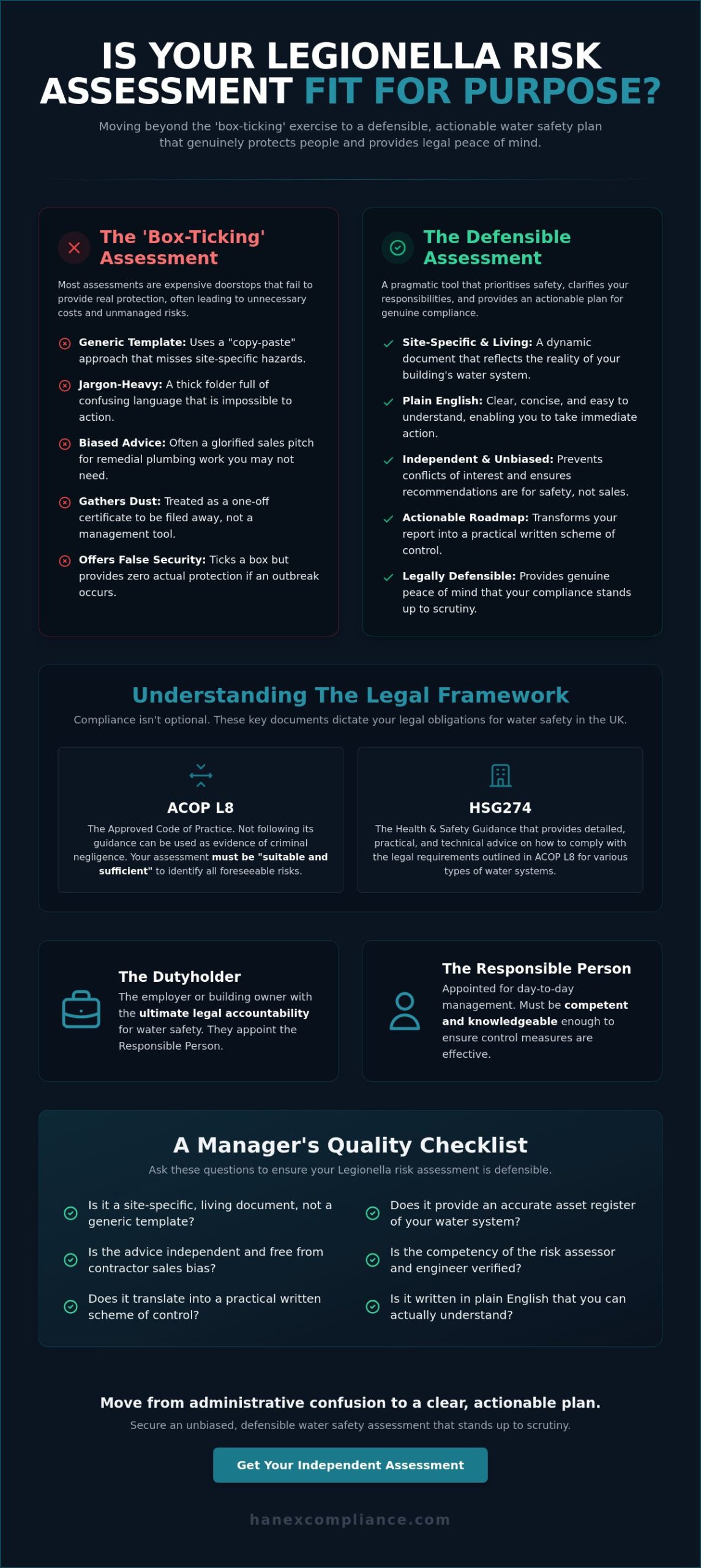
Stop treating your safety documentation as a bureaucratic hurdle. A legionella risk assessment isn’t a one-off certificate to be filed away and forgotten; it’s a living, breathing management tool. Many organisations fall into the trap of using generic, “copy-paste” templates that fail to reflect the actual pipework on their walls. These reports might satisfy a basic audit, but they offer zero protection if an outbreak occurs. A truly site-specific assessment identifies the unique dead legs, temperature fluctuations, and usage patterns that a generic checklist will always miss.
The pragmatic expert view is simple: compliance should support your business, not hinder it. We’ve seen too many managers bogged down by “box-ticking” mentalities that prioritise volume over value. Real water safety comes from a proactive culture where the assessment is used to drive daily decisions. It’s about having a defensible position rooted in reality. If your report doesn’t tell you exactly what to do next Monday morning, it isn’t doing its job.
The Core Purpose: Why We Assess Risk
We assess risk to break the chain of events that leads to infection. This starts with Understanding the Legionella bacterium and how it thrives in man-made water systems. For an outbreak to happen, the bacteria must first be present, then multiply in stagnant or warm water, and finally be inhaled as contaminated droplets by a susceptible person. Our goal is to intercept this process at every stage to protect tenants, staff, and the public.
Under the Control of Substances Hazardous to Health Regulations 2002 (COSHH), conducting a legionella risk assessment is a statutory requirement for all employers and those in control of premises. This isn’t optional. It’s a legal obligation designed to ensure that the risks associated with your specific water system are identified and managed effectively.
Who is the “Responsible Person” and What is Their Role?
The legal hierarchy is clear, yet often misunderstood. The Dutyholder, usually the employer or building owner, has the ultimate legal accountability. However, they typically appoint a “Responsible Person” to manage the day-to-day control measures. This individual must possess sufficient authority, knowledge, and competence to ensure the water system remains safe. Competence doesn’t just mean holding a training certificate; it means having the practical ability to identify when a system is drifting out of control. Understanding the full scope of your responsible person legionella duties is essential before you can effectively manage your site’s water safety obligations.
The Responsible Person needs a report they can actually read. If the assessment is buried under layers of jargon and corporate fluff, it becomes impossible to action. A pragmatic report highlights the most critical risks first and provides a clear roadmap for remediation. You shouldn’t need a PhD in microbiology to understand whether your cold water storage tank needs a new lid or a thorough clean. Clarity is the foundation of accountability.
The Legal Framework: Navigating ACOP L8 and HSG274 without the Jargon
The Health and Safety at Work etc. Act 1974 is the bedrock of UK water safety. It places a clear duty on employers to ensure the health and safety of their employees and anyone else who might be affected by their activities. When it comes to Legionella, you cannot simply claim you were unaware of the risks. Ignorance is never a defensible position in a court of law. If you manage a facility, the burden of proof is on you to show you have taken all reasonable steps to prevent harm. If you’re unsure if your documentation aligns with current ACOP L8 and HSG274 guidance, a quick review can save months of stress and potential legal fallout.
ACOP L8: The Rules You Must Follow
ACOP L8, the Approved Code of Practice, has a unique legal status. While it isn’t law itself, failure to follow its guidance can be used as evidence of criminal negligence in a prosecution. The legislation demands that your legionella risk assessment be “suitable and sufficient.” This means it must be thorough enough to identify all foreseeable risks on your specific site. A generic report that misses a redundant shower or a hidden cold water tank fails this test immediately. Every UK business must meet five core requirements:
- Identify and assess sources of risk.
- Prepare a written scheme for preventing or controlling risk.
- Implement, manage, and monitor those precautions.
- Keep meticulous records of all actions taken.
- Appoint a competent person to oversee the process.
HSG274: The Technical “How-To” for Estates Teams
If ACOP L8 is the “what,” then HSG274 is the “how.” This technical guidance is split into three parts: evaporative cooling systems (Part 1), hot and cold water systems (Part 2), and “other” risk systems like spa pools or pressure washers (Part 3). Most businesses deal primarily with Part 2. It dictates the exact temperatures your water must reach and the frequency of your flushing and descaling tasks. Following generic “best practice” is a gamble. Your site needs a tailored approach that reflects your specific asset register. If your current records feel like a mess of jargon, a Water Hygiene Contract MOT can help verify that your technical procedures actually align with the law. The role of the written scheme of control is to turn this technical guidance into a daily reality for your maintenance team.
Independent Assessments vs. Contractor-Led Reports: Avoiding the Conflict of Interest
Beware the contractor who offers a “free” or suspiciously low-cost assessment. They aren’t doing you a favour; they’re looking for a sales lead. When the same company that identifies a risk also quotes to fix it, the incentive for honesty disappears. You need an unbiased partner who prioritises your safety, not their own quarterly sales targets. It’s the difference between a genuine safety audit and a glorified shopping list for plumbing parts. Choosing an independent path ensures your legionella risk assessment remains a tool for compliance rather than a revenue generator for a third party.
We’ve seen countless reports that recommend thousands of pounds in remedial work that simply isn’t required by law. Independence provides you with a “second pair of eyes” on your water hygiene systems. It allows you to verify that your current service provider is actually delivering the value they promised. By separating the assessment from the remediation, you create a transparent system where every recommendation is based on site-specific risk rather than a desire to sell more pipework.
The Hidden Cost of “Commercial” Risk Assessments
Commercial providers often use a legionella risk assessment as a Trojan horse. They produce reports filled with “essential” remedial actions that are actually just optional upgrades or “nice-to-have” features. You need to know the difference between a strict legal requirement and a contractor’s version of best practice. An independent audit can reduce your annual maintenance spend by identifying and removing redundant tasks that don’t actually improve safety. We act as the honest ally, providing the facts so you can make informed decisions. This pragmatic approach ensures your budget is spent where it matters most, protecting your people without wasting resources on unnecessary “fixes.”
Why Independence Equals Defensibility
Independence isn’t just about saving money; it’s about building a defensible legal position. If an outbreak occurs, a court will look closely at your audit trail. A report produced by an independent expert carries significantly more weight than one from a service provider with a vested interest in finding faults. It shows the HSE that you prioritised objective safety over the convenience of a “one-stop-shop” approach. Maintaining this clear separation proves you’re in control of your site. It creates a robust record of accountability that protects your business from the fallout of biased or incomplete reporting. You don’t just need a report; you need one that stands up to professional scrutiny.
What Makes a Legionella Risk Assessment Defensible? A Manager’s Quality Checklist
A defensible legionella risk assessment must reflect the actual pipework on your wall. If your report contains generic photos of tanks that look nothing like yours, it won’t protect you in court. You cannot manage what you haven’t identified. A high-quality report includes a comprehensive asset register and a schematic diagram. These aren’t optional extras; they’re the map of your water system. Without them, your maintenance team is flying blind. Finally, apply the plain-English test. If your site manager can’t understand the required actions without a technical dictionary, the report is useless for real-world safety.
We’ve seen reports from national providers that are 200 pages long but contain only five pages of site-specific data. This is corporate fluff designed to look impressive while providing minimal value. Your documentation needs to be lean and functional. It should serve as a practical guide for your estates team, not a weight for your office shelf. If the report doesn’t clearly link a specific risk to a specific asset, it isn’t defensible. Accuracy is the only thing that stands up under the scrutiny of an HSE inspector.
Essential Components of a Professional Report
A professional report must be granular. It shouldn’t just mention “tanks”; it should list every calorifier, cold water storage tank, and thermostatic mixing valve (TMV) on site. High-quality assessments include photographic evidence of every identified risk. Seeing a dead leg or uninsulated pipe in a photo makes it much easier to justify a repair budget to senior management. Your action plan must also be prioritised. A generic list of “to-dos” is overwhelming. You need a clear hierarchy that identifies high-risk items requiring immediate attention versus low-risk, long-term improvements.
- Detailed asset register with unique identifiers for every component.
- Site-specific schematic diagrams showing the water flow and key assets.
- Photographs of all non-compliances to provide visual context for repairs.
- A prioritised action plan with clear deadlines and assigned responsibilities.
Reviewing Your Assessment: When is it Outdated?
The idea that you only need a review every two years is a dangerous myth. The law requires a review whenever there is a “significant change” to the system or its use. This could mean a wing of a building being mothballed, a change in the incoming water temperature, or a series of failed water samples. You don’t always need to pay for a full rewrite every year. However, you must verify that your existing controls are still effective. If your system has undergone major modifications, you need a professional legionella risk assessment to ensure your legal protection remains intact. Staying current is about monitoring reality, not just watching the calendar.
Implementing Your Findings: Turning Paperwork into Practical Water Safety
Receiving your legionella risk assessment is the beginning, not the end of your safety journey. If that report stays in a drawer, your legal liability remains exactly where it was before you paid for the survey. You must bridge the gap between identifying a risk and managing it daily. This requires a shift from passive compliance to active control. It’s about ensuring your onsite team actually knows how to flush a dead leg or check a temperature correctly. Real safety happens in the plant room, not the filing cabinet.
Integrating water hygiene into your wider health and safety culture is essential. It shouldn’t be treated as a dark art that only contractors understand. When your team understands the “why” behind the tasks, they’re more likely to perform them diligently. This creates a robust safety culture where risks are spotted and reported before they become expensive problems or health hazards. Investing in practical legionella training for your staff is one of the most effective ways to embed this culture and ensure your written scheme is followed correctly on the ground.
Creating Your Written Scheme of Control
Your written scheme is the “operating manual” for your site’s water safety. It takes the technical recommendations from your assessment and turns them into a schedule of weekly, monthly, and annual tasks. Whether you use a digital system or a physical logbook, your records are your only proof of compliance. If it isn’t recorded, it didn’t happen. You should use your risk assessment as a benchmark to hold your water hygiene contractor to account. Don’t let them dictate the terms; use the report to verify they’re delivering the service you’re paying for.
- Translate assessment findings into a clear, dated task list for maintenance staff.
- Maintain meticulous logbooks to provide a “defensible” audit trail for inspectors.
- Schedule regular reviews of contractor performance against the written scheme.
- Ensure all remedial works are signed off and updated in the asset register.
The Hanex Approach: Straight-Talking Compliance Support
We don’t believe in over-complicating safety to justify higher fees. Our approach focuses on unbiased audits that verify your site’s actual safety levels rather than just ticking boxes. Many organisations find they are overpaying for hygiene services they don’t actually need. A Water Hygiene Contract MOT can identify these inefficiencies, potentially saving you significant resources while strengthening your compliance position.
Competence is the final piece of the puzzle. You need to be certain that the person carrying out your checks is truly capable. We provide Engineer Competency Audits to ensure your onsite team has the practical skills required to keep your systems safe. If you’re tired of opaque reports and hidden agendas, it’s time for a different approach. Get a straight-talking quote for your Legionella risk assessment and secure the peace of mind that comes from honest, independent advice.
Securing Your Defensible Water Safety Strategy
Compliance doesn’t have to be a confusing or expensive burden. You’ve seen how a site-specific legionella risk assessment serves as your most powerful management tool when it’s free from corporate jargon and hidden sales agendas. By prioritising independence and technical accuracy, you move beyond mere box-ticking and into a culture of genuine safety. You now have the checklist to verify report quality and the roadmap to turn paperwork into a practical written scheme.
It’s time to stop paying for fluff and start investing in clarity. We provide expertise in ACOP L8, HSG274, and HTM 04-01 standards to ensure your site remains fully compliant and your people stay protected. Book your independent Legionella risk assessment with Hanex Compliance to receive unbiased advice and plain-English reports you can actually understand. You’re now equipped to take control of your water hygiene with confidence and common sense.
Frequently Asked Questions
Is a Legionella risk assessment a legal requirement for my business?
Yes, it’s a statutory requirement. If you are an employer or a person in control of a premises, you have a legal duty under the Health and Safety at Work etc. Act 1974 and COSHH 2002 to identify and assess the risk of exposure to Legionella. This obligation applies to all workplaces, regardless of the size of the business or the type of industry you operate in.
How often should a Legionella risk assessment be reviewed in the UK?
You must review your assessment regularly and whenever there is reason to believe it is no longer valid. Common triggers for a review include significant changes to your water system, changes in building use, or if new information about risks becomes available. Don’t simply wait for a specific calendar date if your site conditions have changed; a review is about accuracy, not just a schedule.
Can I carry out my own Legionella risk assessment?
You can perform the assessment yourself if you are competent to do so. This means you must have the necessary skills, knowledge, and experience to identify all potential risks correctly. For many complex commercial systems, managers choose an independent professional to ensure the resulting legionella risk assessment is truly defensible and free from internal bias.
What happens if I don’t have a valid Legionella risk assessment?
You face serious legal consequences, including prosecution, unlimited fines, and potential imprisonment. If an outbreak occurs and you cannot produce a valid assessment and a written scheme of control, the Health and Safety Executive (HSE) will view this as a failure to meet your legal duties. It leaves your business entirely unprotected against claims of negligence.
What is the difference between a risk assessment and water testing?
An assessment is a comprehensive review of your entire water system to identify where and how risks might occur. Water testing is a laboratory analysis of a specific sample at a single point in time. Testing is a monitoring tool that supports your management plan; it is not a replacement for a thorough legionella risk assessment that identifies systemic hazards.
What should I look for when hiring a Legionella risk assessment company?
Prioritise independence and transparency. You need a partner who provides unbiased advice and doesn’t use the report as a way to sell you unnecessary remedial plumbing services. Look for providers who promise site-specific reports in plain English rather than generic, jargon-heavy documents that offer little practical value for your maintenance team.
Does a small office with only a kitchen and toilet need a risk assessment?
Yes, all premises where water is used in a way that could create an aerosol must be assessed. While the risks in a small office are often lower than in a large industrial site, the law still requires you to confirm and document this. A pragmatic assessment for a simple site should be brief and focused on the actual risks present without over-complicating the process.
How much does a professional Legionella risk assessment cost?
The cost depends entirely on the size and complexity of your water system and the number of assets involved. A small office with a few taps will naturally require less time to assess than a large hospital or a manufacturing facility with cooling towers. You should always look for a clear, transparent quote that covers the full scope of your specific site requirements. If you want to better understand what your appointed individual is legally required to do before commissioning any work, reviewing a plain-English breakdown of responsible person legionella duties will help you ask the right questions and hold your provider to account.