

A stack of training certificates won’t keep you out of court if your staff can’t identify a dead leg on your specific site. Most businesses treat legionella training as a tedious annual chore, yet they still feel a pang of anxiety when an HSE inspector walks through the door. It’s frustrating to pour budget into generic online modules that leave your team more confused about the differences between ACOP L8 and HSG274 than when they started.
We agree that the current industry standard for compliance is often bloated and ineffective. You need more than just a paper trail; you need staff who can actually spot risks before they become liabilities. This guide moves beyond the fluff to show you how to build a practical water safety programme. We’ll explore the latest 2026 regulatory updates, including the impact of the Renters’ Rights Act, and provide a clear roadmap to ensuring your team is genuinely competent. You’ll learn how to move from simple awareness to a robust, defensible position that protects both your people and your reputation.
Key Takeaways
- Understand why the Health and Safety at Work Act 1974 and COSHH require more than just a paper trail to prove compliance.
- Bridge the gap between basic awareness and genuine competency to ensure your legionella training provides staff with practical, site-specific skills.
- Clearly define the legal liabilities of the Dutyholder and the Responsible Person to ensure accountability at every level of your organisation.
- Recognise the biological risks and aerosol transmission routes that your team must understand to manage water safety effectively.
- Learn how to avoid conflicts of interest by selecting independent training that focuses on safety rather than selling remedial plumbing works.
Beyond Box-Ticking: Why Legionella Training is a Legal Necessity
Legionella training isn’t just about handing out certificates that end up buried in a filing cabinet. It’s the practical process of equipping your staff with the skills to manage and prevent the risks of Legionnaires’ disease. When your team understands how bacteria colonise a water system, they stop being passive observers and start being an active line of defence. This isn’t optional. It’s a fundamental requirement for any business that operates a building with a water system, regardless of its size or complexity.
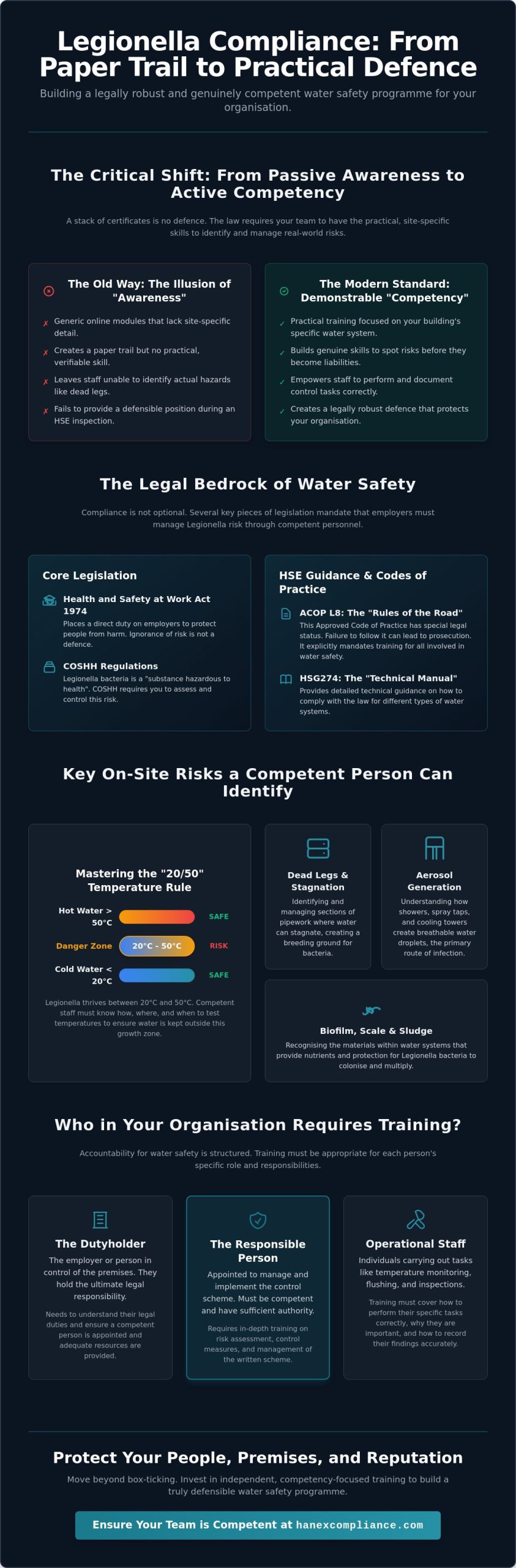
The legal framework is crystal clear. The Health and Safety at Work Act 1974 and the Control of Substances Hazardous to Health Regulations (COSHH) place a direct duty on employers to protect people from harm. In the eyes of the Health and Safety Executive (HSE), ignorance is no defence. If a site is inspected and your staff can’t demonstrate they know what they’re doing, you’re already in breach of the law. You don’t need a case of illness to be prosecuted; you just need a failure in management. Effective legionella training ensures your staff aren’t just aware of the risk, but are actually competent to handle it.
The Legal Pillars: ACOP L8 and HSG274
Think of ACOP L8 as the “rules of the road” and HSG274 as the “technical manual” for your vehicle. ACOP L8 (the Approved Code of Practice) has a special legal status. If you’re prosecuted for a health and safety breach and it’s proved you didn’t follow the relevant provisions of the code, a court will find you at fault unless you can show you complied with the law in some other way. This document explicitly mandates that anyone involved in water safety must be suitably trained. This isn’t a one-and-done exercise. To remain “defensible” during an audit or inspection, training must be refreshed regularly to account for changes in staff, technology, and legislation.
Consequences of Inadequate Training
The fallout from poor training goes far beyond a slap on the wrist. Fines for non-compliance with the Health and Safety at Work Act are now unlimited. Beyond the financial hit, the reputational damage can be terminal for a business. Proper training acts as a shield for the individual tasked with Responsible Person Legionella duties. It provides them with the confidence to make informed decisions and the evidence to prove they’ve acted reasonably. Untrained staff are dangerous because they miss the “obvious” risks. They walk past dead legs in the pipework or ignore water temperatures that have dropped into the danger zone because they haven’t been taught what to look for. Investing in legionella training is the only way to close that gap and secure your site.
What Does Effective Legionella Awareness Training Actually Cover?
Effective legionella training should never feel like a high school biology lecture. While understanding the bacteria is necessary, the focus must remain on practical management. You need to know that Legionella thrives in biofilm, scale, and sludge, but more importantly, you need to know where those things accumulate in your specific building. It’s the difference between academic theory and real-world safety. Staff must be taught to recognise that stagnant water is an invitation for bacterial growth, turning a simple plumbing system into a potential hazard.
The risk isn’t just the presence of bacteria; it’s how that bacteria reaches a human lung. Training must cover the mechanics of aerosol generation. If a water system creates a fine mist, such as through showers, spray taps, or cooling towers, it creates a direct pathway for infection. This is why the HSE Approved Code of Practice (ACOP L8) insists on a management pathway. This process starts with a robust risk assessment and ends with a site-specific written scheme of control that dictates every action your team takes.
Identifying Foreseeable Risk
Competent staff don’t just look at pipes; they see potential hazards. Proper training empowers your team to identify “dead legs”—lengths of pipework where water stagnates—and “blind ends” that serve no purpose but to harbour bacteria. A critical part of this is mastering the “20/50 rule.” Cold water must stay below 20°C, whilst hot water must be stored at 60°C and distributed at 50°C or above. If your team can’t use a thermometer correctly or doesn’t know which outlets to test, your compliance is a myth. This is especially vital for complex systems like spa pools where the risk of aerosolisation is significantly higher.
The Role of the Written Scheme
A generic, “off-the-shelf” written scheme is a compliance trap. It might look impressive in a folder, but it won’t protect you if it doesn’t reflect your actual site. Training must teach staff how to follow and update a site-specific scheme. This includes the daily reality of monitoring and maintenance, such as quarterly showerhead descaling and monthly temperature checks. You aren’t just looking for “pass” results; you’re looking for trends that suggest a system is failing.
Record-keeping is the final, non-negotiable piece of the puzzle. In the eyes of the law, if it isn’t written down, it didn’t happen. Your logbooks are your primary evidence in the event of an inspection. If you’re unsure if your current documentation would stand up to professional scrutiny, an independent Water Hygiene Contract MOT can verify your records are defensible. Genuine legionella training ensures that every entry in that logbook is accurate, timely, and meaningful, providing you with total peace of mind.
Awareness vs. Competency: The Critical Gap in Water Safety
A certificate on a wall is a poor substitute for actual skill. While basic legionella training provides the necessary theory, it rarely guarantees that a technician can handle a complex water system under pressure. Awareness is simply knowing that a risk exists. Competency is the ability to manage that risk correctly, consistently, and safely. Too many organisations mistake a classroom attendance record for a guarantee of safety. This gap between knowing and doing is where most compliance failures happen.
Assumed competency is a silent killer in water safety management. It’s easy to trust a long-term staff member or an external contractor because they’ve “always done it that way.” But habits can become lazy and standards can slip over time. Without regular verification, you’re essentially gambling with your legal liability. Remember that breaches of the Health and Safety at Work Act are criminal offences; prosecution can occur even if no one has become ill. Engineer Competency Audits are the gold standard here. They move beyond the paperwork to verify that the person doing the work actually understands the “why” behind every temperature check and flush.
Verifying Practical Skills on Site
Digital modules have their place, but they can’t replace onsite training. Real-world plumbing is often messy, inconsistent, and site-specific. We advocate for a “watch one, do one” approach. This ensures that technical tasks, such as correctly identifying and flushing a dead leg, are performed to the required standard. It’s about practical application on your specific assets. This process allows Hanex Compliance Ltd to verify that your team is actually following the recommendations laid out in your Legionella risk assessment. If they can’t demonstrate the task in front of an expert auditor, they aren’t competent.
Why Contractor Audits are Essential
Paying for a service doesn’t automatically mean you’re receiving it. You shouldn’t just take your water hygiene contractor’s word for it. Verification of their behaviour on site is a critical part of your duty of care. Independent audits help you identify if a contractor is cutting corners, such as “ghosting” temperature logs or skipping difficult-to-reach outlets. These audits ensure you’re actually getting the compliance you’re paying for. It provides you with a defensible position for your records. If the HSE asks how you know your contractor is doing a good job, you’ll have the independent audit data from Hanex Compliance Ltd to prove it.
Who in Your Organisation Requires Legionella Training?
Not everyone in your business needs the same level of instruction. Giving a receptionist and a maintenance engineer the same legionella training is a waste of resources. It creates a “box-ticking” culture rather than a safe one. You must segment your team based on their actual involvement with the water system. Effective management relies on different people holding different levels of knowledge, from high-level legal awareness to deep technical skill.
The Dutyholder carries the ultimate legal weight. This is typically the employer or building owner. They don’t need to be technical experts, but they must understand the legal stakes. Their role is to ensure the budget and authority exist to keep the building safe. Without this high-level understanding, the rest of the safety chain often falls apart due to a lack of resources or leadership support.
Training for the Responsible Person (RP)
The RP manages the day-to-day control measures. Their training must focus on strategic oversight and contractor management. They need to know how to spot a poor risk assessment and when to challenge a contractor’s findings. The RP must have the authority to act on training recommendations. Strategic training also equips them to handle emergency procedures and communication if a positive sample is returned or an outbreak is suspected.
Maintenance staff and engineers are your front line. They are the people physically taking temperatures, flushing outlets, and descaling showerheads. Their training must be hands-on and technical. If they don’t understand the specific risks of the assets they manage, they are likely to miss critical warning signs. General staff in high-risk settings, such as care homes or leisure centres, also need a baseline of awareness. They should know how to report a tap that isn’t reaching temperature or a shower that has been out of use for several days.
Tailoring Training to the Site
Context is everything. A primary school’s water system is simple compared to a heavy industrial plant with cooling towers and complex process water. Your training programme must reflect the specific assets listed in your water safety plan. When a new engineer joins, a generic certificate isn’t enough. They need a site-specific induction to understand the unique layout and quirks of your plumbing. This ensures they aren’t just following a list; they’re managing your actual risks.
If your team lacks this specific, hands-on knowledge, you are leaving your compliance to chance. Book our Onsite Engineer Training to ensure your staff are competent and confident on your specific site.
Choosing the Right Training: Why Independent Advice Matters
The water hygiene industry has a conflict of interest problem. Many providers offer legionella training as a “loss leader” to get through your door so they can sell you expensive, and often unnecessary, remedial plumbing works. If your trainer is also looking for pipework to replace or valves to install, their advice isn’t truly unbiased. You need a partner who focuses solely on your safety and legal compliance, not their next installation invoice. Independent guidance ensures that the recommendations you receive are based on genuine risk, not a monthly sales target.
Unbiased training allows you to integrate new skills into a larger Water Safety Plan Guidance strategy. Instead of reacting to a salesperson’s list of “must-haves,” you build a defensible system based on the actual needs of your site. Look for providers with real-world experience who speak in plain English. If a trainer hides behind dense technical jargon or over-complicated reports, they’re probably trying to confuse you into spending more. Practicality should always trump ceremony to ensure your people stay safe.
What Makes a Good Legionella Training Course?
Forget “death-by-PowerPoint” sessions that put your team to sleep. A high-quality course should encourage questions and use real-world examples from your actual facility. It must also be current. Standards don’t stay still. In 2026, your training should reflect the latest regulatory updates, including the specific requirements of the Renters’ Rights Act if you manage residential portfolios. Finally, ensure the training isn’t a dead end. It should provide a clear pathway for ongoing competency checks to prove that the knowledge has actually been absorbed and applied in the plant room, not just the classroom.
How Hanex Compliance Ltd Supports Your Team
We take a straight-talking approach to water safety. There is no corporate fluff or unnecessary jargon here; we give you the facts you need to stay safe and compliant. Because we don’t sell plumbing or remedial works, our advice is always 100% independent and focused on your best interests. Hanex Compliance Ltd provides the legionella training your team needs to understand their roles, followed by Engineer Competency Audits to verify that the learning has actually “stuck.” This verifies that your staff are following your specific written scheme correctly. Contact us today to organise a pragmatic review of your current team competency and secure a defensible position for your organisation.
Secure Your Site with Genuine Competency
Compliance in 2026 isn’t a passive state; it’s an active practice. We’ve seen that while basic awareness is a legal starting point, genuine site safety depends on the practical competency of your staff. Whether you’re a Dutyholder or a technician, your legionella training must translate into actionable skill. Sticking to generic modules leaves you vulnerable to HSE scrutiny and site-specific hazards that a classroom certificate simply won’t catch. Practical knowledge is what keeps your water systems safe and your legal position defensible.
You need advice that prioritises your safety over selling you remedial plumbing. As plain-English compliance experts, we provide independent and unbiased audits that verify your team’s skills against ACOP L8 and HSG274 standards. Don’t leave your legal defence to chance. Book a straight-talking Legionella training or competency audit today to ensure your water safety programme is as robust as it is practical. Taking control of your compliance now provides the peace of mind you need to focus on your core business operations with total confidence.
Frequently Asked Questions
Is legionella training a legal requirement for all businesses?
Yes, legionella training is a legal requirement for any organisation that operates a building with a water system. Under the Health and Safety at Work Act 1974 and COSHH regulations, employers must ensure that anyone involved in water safety is suitably trained and competent. ACOP L8 explicitly states that a lack of training is a major factor in legionella outbreaks, making it a primary focus for HSE inspectors.
How often should legionella awareness training be refreshed?
You should refresh your training every two to three years to maintain a defensible position. While the law doesn’t state a specific interval, you must update it if there are changes to your staff, your water system, or the law itself. The introduction of the Renters’ Rights Act on 1 May 2026 is a clear example of a regulatory change that requires a training update for many property managers.
Who is the “competent person” in legionella management?
A competent person is an individual with the sufficient authority, technical knowledge, and experience to perform specific water safety tasks. This isn’t a honorary title. To meet the HSE definition, the person must demonstrate they understand the risks on your specific site and can correctly execute the monitoring and maintenance tasks required by your written scheme of control.
Can I do legionella training online, or does it have to be in person?
You can use online training for basic awareness, but technical competency usually requires an in-person or onsite element. Online modules are an efficient way to teach the biology of the bacteria to general staff. However, for maintenance engineers who need to identify dead legs or take accurate temperatures, onsite legionella training is far more effective as it applies theory to your actual plumbing.
What is the difference between a Dutyholder and a Responsible Person?
The Dutyholder is the person with ultimate legal accountability for water safety, typically the employer or building owner. The Responsible Person is an individual appointed by the Dutyholder to manage the daily control measures and record-keeping. The Dutyholder provides the budget and authority, while the Responsible Person ensures the work is actually done to the required standard.
Does a landlord need legionella training for residential properties?
Yes, landlords must understand their duties to assess and control risks in their rental properties. The Renters’ Rights Act, which took effect in May 2026, has made these legal obligations even more explicit. Basic awareness training ensures a landlord can conduct a valid risk assessment or, at the very least, verify that the contractors they hire are performing the work correctly.
What should be included in a legionella training certificate?
A valid certificate must include the trainee’s name, the date of the course, and a detailed syllabus of the topics covered. It should explicitly reference current standards such as ACOP L8 and HSG274. This document serves as your primary evidence during an audit, proving that your staff have received instruction that is relevant to the current 2026 regulatory landscape.
How do I prove to the HSE that my staff are competent?
You prove competency by providing a combination of training certificates, site-specific records, and evidence of practical skill. Paperwork alone is rarely enough. The HSE will look for a robust written scheme and logbooks that show consistent, accurate monitoring. Independent competency audits are the gold standard for proving that your team can actually apply their training in a real-world environment.