

You can hire a contractor to flush your pipes, but you can’t hire them to take the fall in court. The legal reality of your responsible person legionella duties is that the buck stops with you, regardless of how many service agreements you’ve signed. It’s a role often handed out without enough training, leaving professionals to navigate the dense language of ACOP L8 while fearing heavy fines or even prosecution.
We know the frustration of reading through HSE documents that feel like they were written to be intentionally confusing. You want to keep your building safe without being bullied into unnecessary tests by contractors looking to pad their invoices. This guide provides a direct, jargon-free breakdown of your obligations under ACOP L8 and HSG274, cutting through the corporate fluff to focus on what actually matters for your site safety.
You’ll learn how to define your legal boundaries and manage external contractors with total confidence. We’ll show you how to move from a “box-ticking” mindset to a proactive system that creates a defensible audit trail. By the end, you’ll have a clear understanding of the daily and weekly tasks required to keep your building legal and your records bulletproof.
Key Takeaways
- Understand the legal distinction between the Dutyholder and the Responsible Person to ensure you know exactly where accountability sits in your organisation.
- Master your responsible person legionella duties by creating a site-specific Written Scheme of Control that addresses real risks rather than just ticking boxes.
- Learn why the HSE defines competency through practical application and skills rather than just attendance certificates from a single training course.
- Establish a manageable routine for daily and monthly tasks like temperature monitoring to ensure your audit trail remains defensible and complete.
- Gain the confidence to manage external contractors effectively and avoid paying for unnecessary tests or services that do not strengthen your compliance.
Who is the Responsible Person? Legionella Duties and Legal Definitions
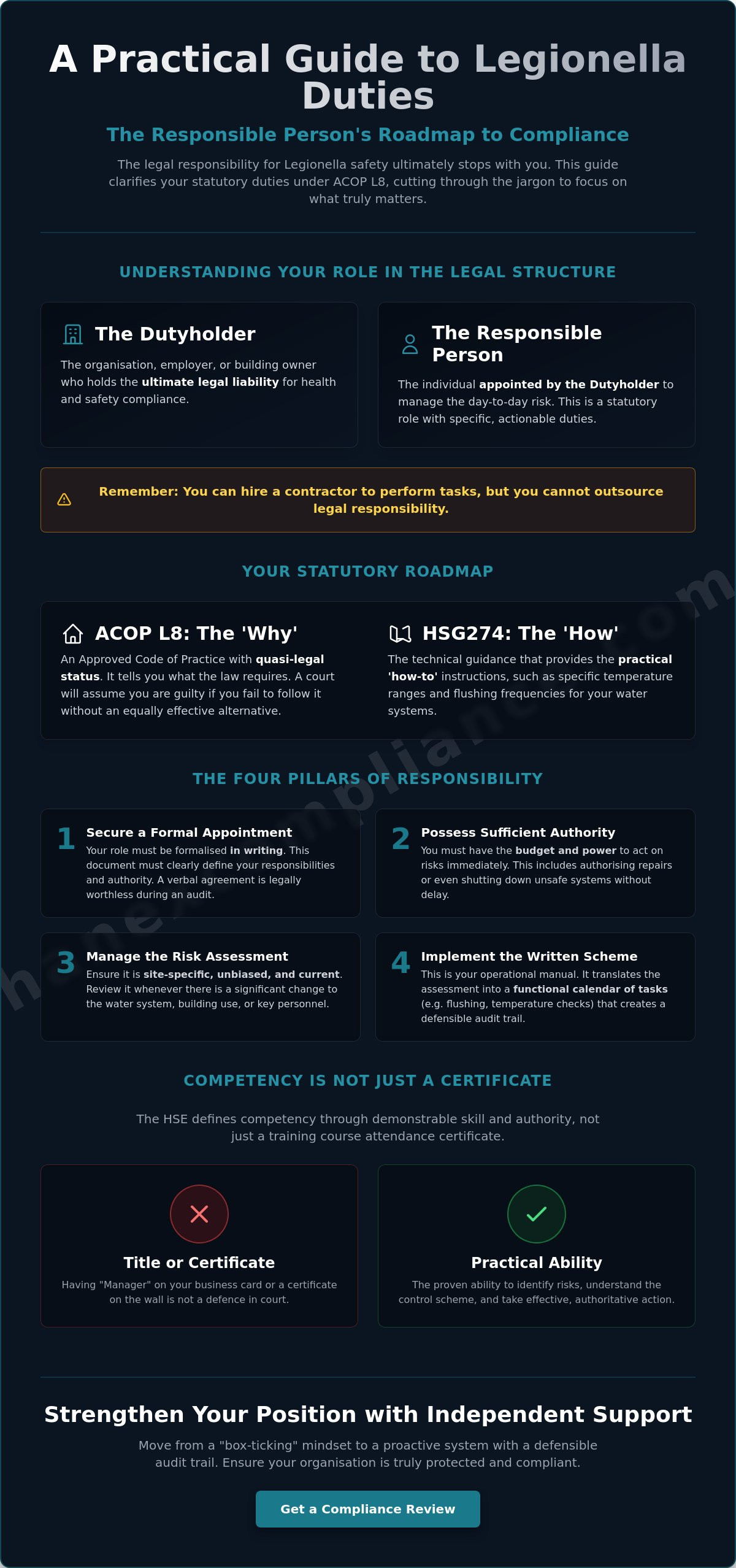
In the eyes of the law, there is a massive difference between the person who owns the business and the person who manages the risk. The Dutyholder is usually the employer or the building owner. They carry the ultimate legal liability. However, they almost always appoint a Responsible Person to handle the daily grind. This is where your responsible person legionella duties begin. This role is not just a line on a job description; it is a statutory appointment rooted in the Health and Safety at Work etc. Act 1974.
You might hear people call ACOP L8 guidance. That is a dangerous oversimplification. It is an Approved Code of Practice with quasi-legal status. This means that if you are prosecuted for a health and safety breach and you haven’t followed the ACOP, a court will assume you are guilty unless you can prove you did something just as effective. It’s a courtroom gamble you don’t want to take. Learn more about Legionella and why the HSE takes these controls so seriously.
Authority is the most overlooked part of the role. An RP who can’t sign off on a £200 repair is not actually a Responsible Person in the eyes of an inspector. The HSE is very clear: you must have sufficient authority to take action. If you identify a risk but have to wait three weeks for a committee to approve a fix, you aren’t fulfilling your duties. You need a budget and the power to shut down a system if it becomes dangerous.
The Appointment Process and Legal Weight
Formalise everything. A verbal agreement is worthless during an audit. Your appointment should be in writing, clearly outlining what you are responsible for and what you aren’t. Titles don’t matter to the HSE; competence does. They want to see that you actually know what you’re doing, not just that you have “Manager” on your business card. In shared premises, this gets even more complex. You must know exactly where your responsibility ends and the landlord’s begins to avoid gaps in your safety records.
ACOP L8 vs. HSG274: Your Statutory Roadmap
Think of ACOP L8 as your legal compass and HSG274 as your technical map. While ACOP L8 tells you what the law requires, HSG274 gives you the technical how-to. Your responsible person legionella duties will look very different if you manage a cooling tower compared to a small office with a couple of sinks. HSG274 is split into three parts to help you manage these specific risks without getting bogged down in irrelevant technical data. It provides the specific temperature ranges and flushing frequencies needed to stay compliant.
The Core Responsibilities: A Practical Breakdown of Statutory Duties
The law doesn’t care about your intentions; it cares about your actions. Once you understand the legal framework, your daily responsible person legionella duties shift toward the practical management of risk. This isn’t about filing a report and forgetting it. It’s about building a living system that proves you are in control. You are the bridge between a theoretical risk and a safe building. If you don’t take that bridge seriously, the whole structure of your compliance will fail.
Managing the Legionella Risk Assessment
A generic, “copy-paste” risk assessment is a liability. If your report doesn’t mention that specific dead-leg in the third-floor toilets or the exact temperature of your calorifier, it’s useless during an audit. You have a duty to ensure your assessment is site-specific and conducted by someone unbiased. Don’t let a contractor who also sells expensive chemicals tell you that you need a £5,000 dosing system without independent verification. Reviewing your assessment every two years is a common myth. You must review it whenever there is a significant change to the water system, the building use, or the personnel managing it. If you’re unsure about your current documentation, a Legionella Risk Assessment review can help verify that your site is actually protected.
Implementing the Written Scheme of Control
The Written Scheme of Control is your operational manual. It translates the technical jargon of a risk assessment into a calendar of functional tasks. This is where many businesses fail. They have the document, but nobody is actually turning the taps. Your job is to assign clear accountability for specific actions. This includes:
- Weekly flushing of infrequently used outlets.
- Monthly temperature monitoring of sentinel points.
- Quarterly descaling and cleaning of showerheads.
- Annual inspections of cold water storage tanks.
Success here is about evidence, not assumptions. If a task isn’t recorded in a logbook, it didn’t happen. The HSE won’t take your word for it. They want to see a robust audit trail that shows exactly who did what and when. This means moving away from messy, handwritten notes toward organised, defensible records. Your responsible person legionella duties include verifying that these logs are accurate and up to date every single month. It’s about creating a culture of accountability where every member of the team knows their role in keeping the water safe. You are not just managing water; you are managing people and data.
Competency vs. Appointment: Why a Title is Not a Defence
A job title is not a legal shield. In the event of an HSE inspection or, worse, an outbreak, the authorities won’t care what your business card says. They will look for evidence of competence. According to the HSE, competence is the combination of training, skills, experience, and knowledge. It is the ability to perform a task safely and effectively. Simply being appointed does not magically grant you these traits. Your responsible person legionella duties require you to be more than just a name on a document; you must be an active, informed manager of risk.
Many organisations send a staff member on a one-day awareness course and assume the box is ticked. This is a dangerous mistake. A short course provides awareness, not mastery. It doesn’t teach you how to troubleshoot a failing thermostatic mixing valve or how to challenge a contractor who is cutting corners. Competence is about knowing what “good” looks like on your specific site. It’s about having the confidence to stop a process when the data suggests the system is out of control. You can’t manage what you don’t understand. Our guide to legionella training for compliance and competency in 2026 explains how to build a practical water safety programme that goes beyond generic certificates.
Verifying Contractor Performance
Blind trust is the enemy of compliance. You might pay a water hygiene company thousands of pounds every year, but the legal responsibility for their failures remains with you. You need to verify that their engineers are actually doing what they say they are doing. Ask them specific questions. How did they calibrate their thermometer? Why is a particular sentinel point consistently under temperature? If you notice that records look too perfect, perhaps every temperature for the last six months is identical, you are likely looking at “pencil-whipping.” This is when engineers fabricate results instead of taking real measurements. Performing regular Engineer Competency Audits is the only way to ensure the work you are paying for is actually being done to the required standard.
The Need for Independent Auditing
There is a clear conflict of interest when the company performing the maintenance is also the one auditing the quality of that maintenance. They are essentially marking their own homework. To build a truly defensible case, you need independent verification. An unbiased third party can spot the gaps that a regular service provider might overlook, or intentionally hide. This independent support protects you from contractor failure and ensures that your site-specific skills are sharp. It’s about moving from a position of hope to a position of certainty. When you can prove that you have actively verified the skills of everyone working on your system, your compliance position becomes significantly stronger.
Maintaining the Written Scheme: Daily, Weekly, and Monthly Priorities
Compliance is not a one-off event. It is a relentless cycle of monitoring, recording, and acting. Your responsible person legionella duties demand a rigid routine that leaves no room for guesswork. If you treat water safety as a “when I have time” task, you are inviting a failure that could have legal consequences. A robust Written Scheme of Control prioritises thermal control because heat is the most effective way to kill the bacteria. Hot water must be stored at 60°C or higher, whilst cold water must remain below 20°C to prevent the growth range of 20°C to 45°C from taking hold.
You will occasionally find results that fall out of specification. A sentinel point might hit 48°C instead of the required 50°C. Don’t panic, but don’t ignore it either. Your scheme must dictate exactly what happens next. This usually involves re-testing, investigating the calorifier settings, or checking for faulty valves. Every action you take must be documented. The HSE requires you to keep these records for at least five years. This five-year rule is your safety net; it proves a history of diligence if you are ever questioned. If you are struggling to keep your logs organised, our Water Hygiene Contract MOT can identify exactly where your audit trail is failing.
High-Frequency Tasks: Flushing and Temperatures
Weekly flushing is the simplest but most neglected part of Legionella control. Any outlet that isn’t used at least once a week is a risk. You must identify these “little-used” points and ensure they are flushed for several minutes. Logging this is vital. Monthly temperature checks focus on sentinel points; the outlets closest and furthest from your water source. Whilst performing these checks, engineers should stay alert for changes in the building, such as new partitions or capped-off pipes, which create dangerous dead-legs in the system.
Quarterly and Annual Requirements
Every three months, you must descale and disinfect showerheads and spray taps. Limescale provides a perfect home for bacteria to hide and multiply. On an annual basis, your focus shifts to the cold water storage tanks. You need a detailed inspection report that checks for debris, vermin ingress, or signs of corrosion. The Responsible Person must review the entire control scheme at least once a year. This isn’t a formality. You are checking if the scheme is still fit for purpose or if changes in building occupancy have rendered your current plan obsolete.
Strengthening Your Position: Training and Independent Support
Mastering your responsible person legionella duties isn’t about memorising the entire HSG274 technical guidance. It is about closing the gap between what you currently know and what the law expects you to prove during a surprise audit. Most professionals find themselves in a “fire-fighting” mode, reacting to high temperature readings or late contractor reports rather than controlling the narrative. This reactive stance is exhausting and, more importantly, legally vulnerable. Strategic management means moving away from these frantic fixes toward a system of verified control.
Training should be practical, not just academic. There is a time for basic Legionella Awareness Training for general staff, but as the Responsible Person, you need a different level of insight. You need to know how to verify the work of others. We favour Onsite Engineer Training because it focuses on the real-world pipework in your specific building, not a generic diagram in a classroom. When your engineers can demonstrate hands-on competency, your audit trail becomes significantly more defensible. Every training session must be recorded in your competency log. If it isn’t documented, as far as the HSE is concerned, it never happened. For a detailed breakdown of how to structure an effective programme, our pragmatic guide to legionella training and competency covers the 2026 regulatory landscape and what it means for your site.
Choosing the Right Training Path
Don’t settle for “box-ticking” courses that leave you with more questions than answers. You need plain-English training that explains exactly what to do when a system fails. This is the difference between having a certificate and having competence. Your engineers need to understand the “why” behind every temperature check and every flush. High-quality training strengthens your team’s ability to spot broader system changes before they become high-risk hazards. It turns your staff into a proactive shield against bacterial growth.
The Hanex Compliance Ltd Approach to Support
The water hygiene industry is full of service providers who want to sell you more chemicals, more frequent testing, or expensive equipment you don’t need. We do things differently. We provide independent, unbiased consulting that removes the commercial bias from your water hygiene management. Our Water Hygiene Contract MOT is designed to find the hidden risks and unnecessary costs that your current provider might be missing. It is a straight-talking assessment of your actual compliance status that puts the power back in your hands.
By using clear Water Safety Plan Guidance, you can streamline your administrative burden and focus on the tasks that actually reduce risk. You don’t need more paperwork; you need better, more focused paperwork. Moving to a strategic management model gives you peace of mind and professional security. You can Contact Hanex Compliance Ltd for a straight-talking audit of your site and finally get the clarity you need to stay safe and legal.
Take Control of Your Site Compliance
Navigating your responsible person legionella duties effectively means moving beyond the stress of administrative clutter. By implementing the site-specific routines and verification methods we’ve discussed, you shift the focus from simple compliance to genuine safety. This transition ensures that your water systems aren’t just legal on paper, but managed with the technical precision required to keep people safe. You now have the roadmap to challenge ineffective contractor habits and maintain the five-year audit trail that protects your organisation.
Effective water hygiene management shouldn’t be a drain on your resources or your sanity. It requires a partner who values transparency and practical results over corporate ceremony. By prioritising independent oversight and hands-on training, you create a defensible position that stands up to the closest scrutiny. You’ve seen the flaws in the standard industry approach; now it’s time to apply a more pragmatic, honest standard to your own building.
Get straight-talking advice on your Legionella duties from Hanex Compliance Ltd and secure your site’s safety. You’ve got this.
Frequently Asked Questions
What are the main duties of a Legionella Responsible Person?
The main responsible person legionella duties involve the day-to-day management of water safety on site. You must implement the Written Scheme of Control, ensure temperature monitoring is performed, and verify that all remedial actions are completed. It’s about maintaining a defensible audit trail rather than just filing reports. You are also responsible for overseeing contractors and ensuring that any site staff performing tasks are actually competent to do so.
Can I be held personally liable for a Legionella outbreak?
Yes, you can be held personally liable if you fail to fulfil your statutory obligations. Under the Health and Safety at Work etc. Act 1974, both the Dutyholder and the Responsible Person can face prosecution for negligence. Fines can be unlimited, and in cases of extreme failure, custodial sentences are possible. This is why having sufficient authority and a clear record of your actions is vital for your professional security.
How often should a Legionella Risk Assessment be reviewed?
You should review your Legionella Risk Assessment whenever there is a significant change to the water system or how the building is used. While there is no fixed legal expiry date, industry best practice in 2026 suggests a review every one to two years. If you change a calorifier, cap off pipework, or experience an “out-of-spec” result, you must update the assessment immediately to ensure your controls remain valid.
Is Legionella training a legal requirement for the Responsible Person?
Yes, the HSE requires the Responsible Person to be competent, which necessitates specific training and experience. You don’t need a degree in microbiology, but you must understand the risks and the technical requirements of ACOP L8. Practical, plain-English training is often more effective than academic courses because it focuses on the real-world tasks you perform. Without documented training, you cannot prove competence during a regulatory audit.
What is the difference between a Dutyholder and a Responsible Person?
The Dutyholder is typically the employer or building owner who carries the ultimate legal responsibility for health and safety. The Responsible Person is the individual appointed by the Dutyholder to manage the technical and administrative aspects of Legionella control. While the RP handles the daily responsible person legionella duties, the Dutyholder remains liable for ensuring the RP has the budget, time, and authority to do the job properly.
What should be included in a Legionella Written Scheme of Control?
Your Written Scheme of Control must include a schematic diagram of the water system and a detailed description of its safe operation. It should outline the specific monitoring tasks, such as monthly temperature checks and weekly flushing, along with clear action levels for when things go wrong. It’s a practical manual for your site, not a generic document. It must also list the names and responsibilities of everyone involved.
How long must Legionella monitoring records be kept?
You must keep Legionella monitoring and inspection records for at least five years. This includes temperature logs, flushing records, and any chemical dosing data. Risk assessments and the Written Scheme should be kept throughout the period they are current and for at least two years afterwards. Maintaining this five-year audit trail is your primary defence if the HSE ever investigates your site following a complaint or an incident.
Do I need a Responsible Person if I only have a small office?
Yes, every commercial premises regardless of size must have a designated person responsible for water safety. In a small office with a simple hot and cold water system, the risk is usually low, meaning the control measures are simpler. You still need a valid risk assessment and a basic Written Scheme. You don’t need complex chemical dosing, but you must still ensure that water is stored and distributed at the correct temperatures.